Struggling to get pregnant can feel confusing and emotionally draining, especially when your menstrual cycle is irregular or unpredictable. Many women start noticing signs like missed periods, long cycles, or no clear ovulation, but are unsure what it actually means for fertility.
In many cases, the real issue is not infertility, but irregular or absent ovulation, which makes it difficult for an egg to be released at the right time for conception. This is one of the most common yet treatable causes of fertility challenges, and for many women, it can even be managed with a complete Ovulation Induction treatment plan.
In this complete guide on “Who Needs Ovulation Induction? Common Medical Reasons”, we’ll walk you through everything in a simple, clear way—what it is, why it’s used, who actually needs it, and how it can support your journey toward pregnancy.
In fertility care, one of the most common issues is irregular ovulation. In fact, many women who have difficulty conceiving are not completely infertile—they simply do not ovulate regularly.
Ovulation induction is recommended because:
Doctors often use it as a first-line treatment before moving to more advanced procedures.
To understand ovulation induction, it helps to understand how the natural cycle works.
In a normal menstrual cycle:
In ovulation induction, medications are used to gently “guide” or stimulate this process. These medications help:
The goal is not to override the body but to support it when natural hormone signaling is weak or irregular.

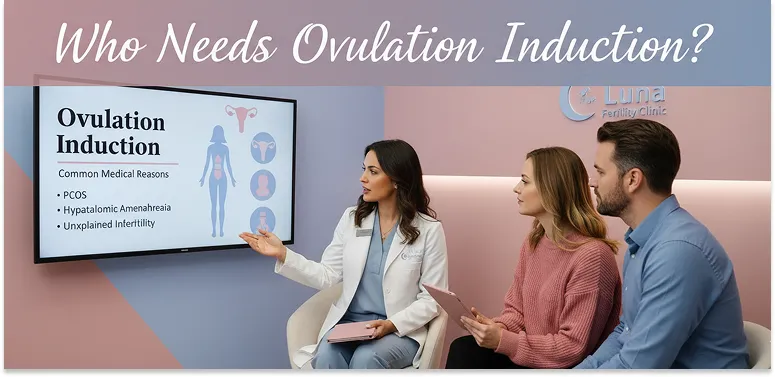
Ovulation induction is not for everyone. It is mainly used when there is a clear medical reason affecting ovulation.
Let’s look at the most common conditions.
Polycystic Ovary Syndrome is one of the leading causes of irregular ovulation.
In PCOS, hormone imbalance affects how the ovaries function. Instead of releasing a mature egg each month, the ovaries may produce multiple small follicles that do not develop properly.
Why is ovulation induction used in PCOS?
Many women with PCOS respond very well to medications like letrozole or clomiphene citrate.

Some women do not ovulate every month, or may not ovulate at all. This condition is called anovulation.
Common signs include:
Ovulation induction helps stimulate the ovaries so that ovulation becomes more predictable and consistent.

Hypothalamic Amenorrhea happens when the brain temporarily stops sending proper hormonal signals to the ovaries.
This can be caused by:
In this condition, the ovaries are usually healthy, but they are not being “instructed” to ovulate.
Ovulation induction can help restart this hormonal communication, although lifestyle correction is also very important.
Diminished Ovarian Reserve refers to a lower number or quality of eggs in the ovaries.
This condition may occur due to:
Ovulation induction is sometimes used to maximize the chances of retrieving or releasing the remaining viable eggs, especially when combined with fertility monitoring.
In some couples, all fertility tests appear normal, but pregnancy still doesn’t happen. This is known as unexplained infertility.
In these cases, ovulation induction may help by improving ovulation timing, increasing the chances of releasing a healthy egg, and supporting treatments like IUI. Even without a clear cause, it can still improve the chances of conception.
Secondary hormonal or medical issues can also affect ovulation. Problems like thyroid imbalance, high prolactin, insulin resistance, weight changes, or chronic illness can disrupt the cycle.
Once the main issue is treated or controlled, ovulation induction may be used to help restore regular ovulation and improve chances of pregnancy.

Ovulation induction is usually recommended for women who are not ovulating regularly or at all.
It helps improve ovulation and increases the chances of natural conception after proper medical evaluation.
Ovulation induction is typically suitable for:
Before starting treatment, doctors usually perform:

Ovulation induction is not suitable for every fertility case. It may not work or be advised when there are serious underlying issues affecting natural conception.
In such situations, doctors may suggest other treatments instead of ovulation induction based on the specific cause of infertility.
It may not be recommended in:
In these situations, more advanced IVF treatments may be more appropriate.
Doctors may prescribe different medications depending on the condition:
The choice depends on age, diagnosis, and response to previous cycles.
Ovulation induction is carefully monitored to ensure safety and effectiveness.
A typical cycle includes:
Monitoring is important to avoid overstimulation and improve success rates.
Success varies depending on the underlying cause:
Age is one of the most important factors influencing outcomes.
Ovulation induction is one of the most important and commonly used treatments in reproductive medicine. It helps women who are not ovulating regularly or who face hormonal challenges to improve their chances of natural conception.
From conditions like PCOS to unexplained infertility, this treatment plays a key role in restoring balance to the reproductive system and supporting pregnancy planning.
However, it is not a one-size-fits-all solution. Proper diagnosis, careful monitoring, and personalized treatment planning are essential for the best results.