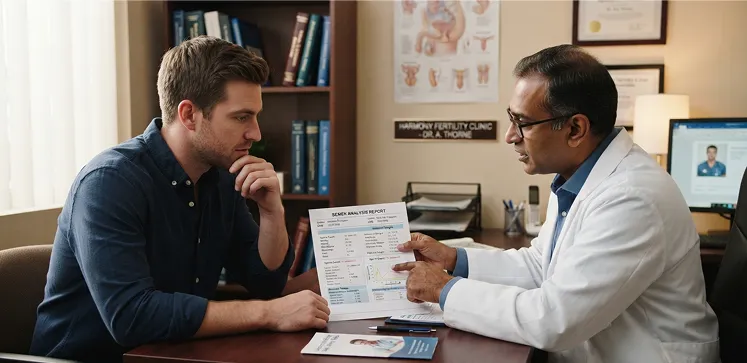
Male fertility tests help identify whether sperm count, sperm quality, hormones, or other reproductive factors may be affecting your ability to conceive.
If you have been trying to have a baby without success, fertility testing can help find possible causes. Many tests are simple, and an abnormal result does not always mean that pregnancy is impossible.
The right test depends on your symptoms, medical history, and previous fertility results. For many men, the evaluation starts with a semen analysis and may include other tests if needed.
There is no single test that can assess every aspect of male fertility. Different tests look at different parts of the reproductive system.
A semen analysis, also called a sperm test, is usually the first fertility test for men.
It examines a semen sample and provides information about several important sperm characteristics, including:
The results can help identify problems such as a low sperm count, reduced sperm movement, or abnormal sperm morphology.
Because sperm production can vary from one sample to another, a healthcare professional may recommend repeating the test before making conclusions based on one result.
Hormone tests use a blood sample to check hormones involved in sperm production and reproductive function.
Depending on the situation, testing may include hormones such as:
Hormone testing may be particularly useful when semen analysis shows a low sperm count, sperm are absent, or symptoms suggest a hormonal problem.
A sperm DNA fragmentation test checks the quality of the genetic material inside sperm. Unlike a semen analysis, it looks beyond sperm count and movement.
It may be considered when there are:
This is usually an additional test, not the first fertility test for every man.
Genetic fertility testing looks for genetic or chromosomal factors that may affect sperm production.
It may be recommended when sperm count is extremely low or no sperm are found in the semen.
Depending on the situation, testing may look for:
The results may help explain the cause of infertility and guide future fertility treatment.
Imaging tests can provide information about the testicles, reproductive organs, and structures involved in sperm production or transport.
A scrotal ultrasound can help identify conditions such as:
Other imaging may be considered when a healthcare professional suspects a blockage or another structural problem affecting sperm transport.
Not every fertility concern can be answered with a semen analysis or blood test.
Depending on the findings, a specialist may consider additional investigations, such as:
These tests are usually selected based on individual circumstances rather than performed routinely.
Understanding the difference between basic and advanced testing can make the fertility testing process less confusing.
Basic testing commonly begins with:
This initial assessment can provide a useful picture of sperm production and reproductive health.
Advanced testing may be recommended when initial results are abnormal, fertility problems remain unexplained, or there is a specific medical concern.
It can include sperm DNA fragmentation testing, genetic testing, ultrasound, and other specialized investigations.
Advanced testing is not automatically better. The most useful test is the one that addresses the specific fertility question.
Usually, no.
Having every available fertility test is not necessary for most men. Testing is normally guided by the results of the initial assessment.
For example, a man with a normal semen analysis and no concerning medical history may not need extensive genetic or imaging tests.
On the other hand, someone with severely reduced sperm production may need additional blood tests, imaging, or genetic investigations.
This step-by-step approach can avoid unnecessary testing while helping identify problems that actually require attention.
Choosing a fertility test should be based on the reason you are seeking testing rather than simply selecting the most advanced option.
Different concerns can point toward different tests.
For example:
A fertility specialist can help determine which tests are relevant to your particular situation.
Previous surgery, testicular injury, infections, medications, hormonal treatment, childhood reproductive problems, and previous fertility treatment can all affect which tests are appropriate.
Your partner’s fertility evaluation may also influence the timing and extent of your own testing.
Consider speaking with a fertility specialist clinic if you have been trying to conceive without success, particularly if there are known risk factors for male infertility.
It can also be helpful to seek specialist advice sooner if you have:
A specialist can review your history and avoid unnecessary testing by creating a more targeted evaluation.
For most men, a semen analysis is the best place to start. It checks key sperm factors and can help determine whether further testing is needed.
Depending on your situation, your doctor may recommend:
Your symptoms, medical history, and previous fertility results will help determine which test is most appropriate.
Learn more
Each male fertility test looks at a different aspect of reproductive health. The table below gives a quick overview of what each test is designed to assess.
| Male Fertility Test | Main Purpose |
| Semen analysis | Sperm count, movement, and shape |
| Hormone testing | Hormone levels and sperm production |
| Sperm DNA test | Sperm DNA quality |
| Genetic testing | Genetic or chromosomal issues |
| Scrotal ultrasound | Testicular health and varicocele |
| Additional sperm tests | Specific sperm problems |
| Urine testing | Possible retrograde ejaculation |
At-home and clinic-based fertility tests can both provide useful information about male reproductive health.
However, they differ in how much they can assess and how the results are interpreted.
Feature | At-Home Tests | Clinic-Based Tests |
Convenience | Very convenient | Requires a visit |
Privacy | More private | Clinical setting |
Sperm testing | Basic results | Detailed results |
Semen analysis | Limited | Comprehensive |
Hormone testing | Some options | Blood testing |
Advanced tests | Usually limited | Widely available |
Expert review | Basic guidance | Specialist review |
Best for | Initial screening | Full assessment |
Follow-up | May need clinic testing | Further tests available |
What happens next depends on your test results. Normal results may mean looking at other fertility factors, while abnormal results may require further testing to find the cause.
Your healthcare professional may recommend:
An abnormal result does not necessarily mean you cannot conceive naturally.
Your overall fertility picture, including your medical history and your partner’s fertility, should be considered.
Male fertility testing is about choosing the right test for your specific concern, not taking every available test.
For many men, a semen analysis is the starting point. Depending on the results and your medical history, additional tests may be recommended.
If you are unsure where to start, a fertility specialist can help identify the most appropriate tests and guide you through the next steps.