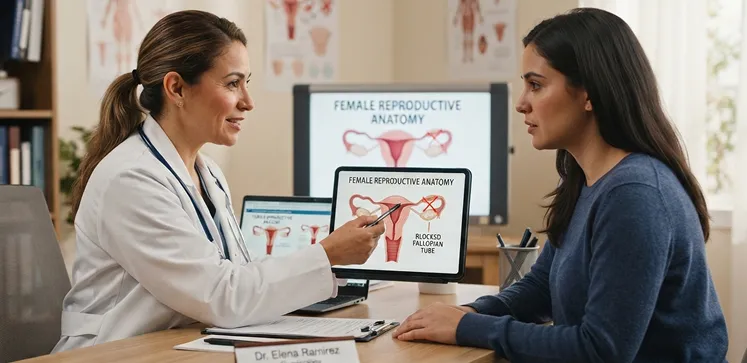
Blocked fallopian tubes are a common cause of fertility problems. They can prevent the egg and sperm from meeting, making natural pregnancy more difficult.
Many people have no clear symptoms and only discover a blockage during fertility testing. The condition can affect one or both tubes and may result from infection, endometriosis, previous surgery, or other causes.
Treatment depends on the extent of the blockage. Options may include tubal procedures or IVF, which can bypass the fallopian tubes and help achieve pregnancy.
Blocked fallopian tubes occur when an obstruction prevents the normal movement of an egg, sperm, or fertilised egg through a fallopian tube. The blockage may affect one tube or both.
A tube can become blocked near the ovary, in the middle section, or closer to the uterus. The severity also varies. Some blockages are partial, while others completely prevent movement through the tube.
Scar tissue and inflammation are common reasons for blocked tubes. Conditions such as pelvic inflammatory disease (PID), endometriosis, previous pelvic surgery, and certain infections can damage or narrow the tubes.
Several conditions can cause fallopian tube blockage or damage, including:
Blocked fallopian tubes often do not cause obvious symptoms. Many people only learn about the condition during an infertility evaluation.
Possible signs can include:
The symptoms usually depend on the condition causing the blockage rather than the blockage itself.
For example, endometriosis or PID may cause pelvic pain even when the tubal blockage itself causes no sensation.
Learn more
Fallopian tubes play an important role in natural conception. After ovulation, the egg enters a fallopian tube, where it can meet sperm and become fertilised. The early embryo then travels through the tube toward the uterus.
A blockage can interfere with one or more of these steps. If one tube is open, pregnancy may still occur, although fertility can be reduced depending on the underlying condition.
If both tubes are blocked, natural conception becomes much more difficult because the egg and sperm cannot meet normally.
A damaged tube can also increase the risk of ectopic pregnancy, particularly when the tube is narrowed or scarred rather than completely closed.
Because blocked tubes often have no symptoms, testing is important when tubal infertility is suspected.
Common diagnostic tests include:
An HSG is an X-ray procedure in which contrast dye is introduced through the cervix. The dye helps show whether it can pass through the uterus and fallopian tubes.
Ultrasound-based tests may be used to assess the uterus and, in some cases, whether fluid can pass through the fallopian tubes.
Laparoscopy is a minimally invasive surgical procedure that allows a fertility specialist to directly examine the pelvis, fallopian tubes, ovaries, and surrounding tissue. It can also help identify conditions such as endometriosis and pelvic adhesions.
Your fertility specialist may recommend one or more tests depending on your symptoms, medical history, and fertility goals.
Treatment depends on where the blockage is, how severe it is, whether one or both tubes are affected, and the condition that caused it.
Possible approaches include:
Not every blockage can or should be surgically opened. A fertility-specialised clinic can help determine whether surgery or IVF offers the better chance of pregnancy.
Yes, pregnancy may still be possible if one fallopian tube is blocked and the other is healthy. If both tubes are completely blocked, natural pregnancy is usually not possible.
A fertility specialist can check your tubes and recommend the most suitable treatment.
There is currently no reliable natural treatment that can physically remove significant scar tissue or completely open a blocked fallopian tube.
Healthy lifestyle habits can support overall reproductive health, but they should not be considered a replacement for medical assessment. Be cautious about products, supplements, herbal remedies, or fertility techniques that claim to naturally clear blocked tubes without clinical evidence.
If a blockage is suspected, proper testing is the best way to understand its location and severity.
Having blocked fallopian tubes does not always mean you cannot have a baby. The impact depends on whether one or both tubes are affected and how much damage is present.
With one healthy tube, natural pregnancy may still occur. With bilateral blockage, IVF can bypass the tubes. However, severe tubal damage, especially hydrosalpinx, may affect fertility treatment outcomes and may need to be addressed before embryo transfer.
Because every fertility situation is different, treatment should be based on an individual assessment rather than the diagnosis alone.
Consider speaking with a fertility specialist if you have been trying to conceive without success, particularly if you have a history of:
A specialist can assess your ovarian reserve, ovulation, uterus, fallopian tubes, sperm health, and other fertility factors to develop a treatment plan suited to your situation.
The right treatment depends on the type and location of the blockage, the condition of the tubes, and your overall fertility picture.
Treatment option | When it may be considered | Main purpose |
Tubal cannulation | Certain blockages near the uterus | Open the affected tube |
Laparoscopic surgery | Selected cases with adhesions or endometriosis | Remove or treat pelvic damage |
Tubal repair | Some surgically treatable tubal damage | Restore tubal function |
Hydrosalpinx treatment | Fluid-filled, damaged tube | Reduce the impact of tubal disease |
IVF | Both tubes blocked or severely damaged | Bypass the fallopian tubes |
Blocked fallopian tubes can make natural conception more difficult, but they do not automatically mean that pregnancy is impossible. Some people can conceive with one healthy tube, while others may benefit from tubal treatment or IVF.
Because blocked tubes often cause no clear symptoms, fertility testing is important when there is a concern about tubal health.
A fertility specialist can identify the cause and location of the blockage and explain whether surgery, IVF, or another approach is most appropriate for your individual circumstances.