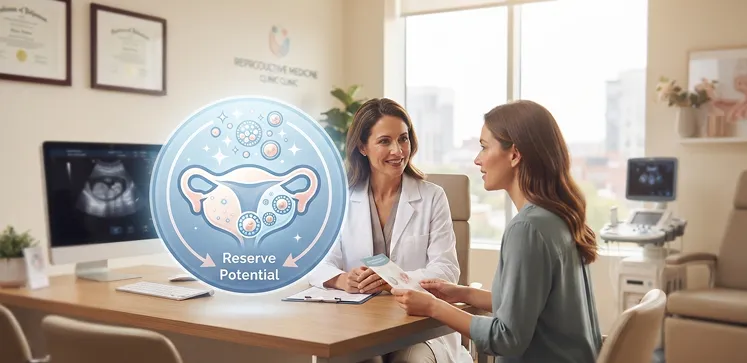
Trying to conceive can be harder when the ovaries have fewer eggs than expected for a woman’s age. This is known as diminished ovarian reserve (DOR) or low ovarian reserve.
Ovarian reserve naturally decreases with age, but it can also be affected by certain medical conditions, treatments, or ovarian surgery.
DOR does not mean pregnancy is impossible. However, it can affect fertility and how the ovaries respond to treatments such as IVF.
Ovarian reserve means the number of eggs remaining in the ovaries. This egg supply naturally decreases with age, and the quality of the eggs can also decline over time.
Diminished ovarian reserve (DOR) means there are fewer eggs available than expected for a woman’s age. Some women with low ovarian reserve still have regular periods and may not notice any symptoms.
Ovarian reserve tests can help estimate egg quantity and how the ovaries may respond to fertility treatment. However, they do not directly measure egg quality or predict pregnancy on their own.
Age is one of the most important factors associated with a decline in ovarian reserve. However, low ovarian reserve can occur earlier than expected for several reasons.
Possible causes and contributing factors include:
Having a lower ovarian reserve does not necessarily mean that a woman has reached menopause or cannot ovulate.
Diminished ovarian reserve (DOR) often has no clear symptoms. Many women still have regular periods and feel completely healthy.
Some possible signs include:
However, these signs do not confirm DOR. It is usually diagnosed through fertility tests, especially when someone is having trouble conceiving.
Learn more
A fertility specialist may use several tests to assess ovarian reserve.
No single test gives a complete picture, so doctors usually consider the results together with age, medical history, menstrual patterns, and other fertility factors.
Common tests include:
AMH is produced by small follicles in the ovaries. An AMH blood test can provide an estimate of ovarian reserve and is commonly used during fertility assessments.
A lower AMH level may suggest a reduced number of remaining follicles, although the result must be interpreted in the context of the individual patient.
An antral follicle count is performed using a transvaginal ultrasound. The fertility specialist counts small developing follicles in the ovaries.
A lower follicle count can be associated with diminished ovarian reserve.
An FSH blood test, often performed early in the menstrual cycle, may also provide information about ovarian function.
Higher-than-expected FSH levels can sometimes indicate reduced ovarian reserve.
Your fertility specialist may recommend one or more of these tests rather than relying on a single result.
Diminished ovarian reserve (DOR) means fewer eggs are available for ovulation and fertilisation. This can make it harder to conceive, especially as age also affects egg quality.
DOR can affect fertility in a few important ways:
Having low ovarian reserve does not mean pregnancy is impossible.
If you are concerned about your infertility, an early assessment can help you understand your options.
In vitro fertilisation (IVF) may be considered for women with diminished ovarian reserve, depending on their individual circumstances.
During IVF, fertility medications are used to stimulate the ovaries so that multiple follicles can develop. When ovarian reserve is low, the ovaries may produce fewer eggs in response to stimulation than expected.
This does not necessarily mean that IVF will fail. Even a small number of eggs may provide an opportunity to create embryos.
A fertility specialist may adjust the stimulation protocol based on factors such as age, AMH, antral follicle count, previous treatment response, and overall reproductive health.
There is no single treatment that can restore ovarian reserve to its original level. Instead, fertility treatment focuses on making the best possible use of the eggs that remain.
Depending on the individual situation, options may include:
The right option depends on age, ovarian reserve, fertility history, partner factors, and personal goals.
At present, there is no proven treatment that can increase the number of eggs a woman has or reverse the natural loss of ovarian reserve.
Healthy lifestyle choices can support general reproductive and overall health, but they cannot create new eggs or restore ovarian reserve.
Be cautious with supplements, medications, or procedures advertised as ways to “rejuvenate” the ovaries.
Some treatments marketed for low ovarian reserve do not have strong evidence showing that they can reliably increase egg numbers or improve the chance of a healthy pregnancy.
A fertility specialist can help separate evidence-based treatment from options that may have limited or uncertain benefits.
A diagnosis of diminished ovarian reserve does not automatically rule out pregnancy.
Some women with low ovarian reserve conceive naturally, while others may need fertility treatment.
The likelihood of pregnancy depends on several factors, including:
Because age affects both egg quantity and quality, delaying a fertility assessment may not be advisable when there are already concerns about ovarian reserve.
If you have been told that your AMH is low or your antral follicle count is reduced, it may be helpful to speak with a fertility-specialised clinic.
You should also consider an earlier fertility assessment if you:
A fertility specialist can look at your test results, age, and overall fertility health to help you understand your options.
Diminished ovarian reserve means that the number of eggs remaining in the ovaries is lower than expected for a woman’s age.
It can make conception more challenging and may affect the number of eggs retrieved during IVF, but it does not mean pregnancy is impossible.
Tests such as AMH, antral follicle count, and FSH can help assess ovarian reserve. Because ovarian reserve cannot currently be restored, early assessment and personalised fertility planning can be especially valuable.
If you have concerns about your ovarian reserve or fertility, discussing your results with a qualified fertility specialist can help you understand what they mean and which options may be appropriate for you.