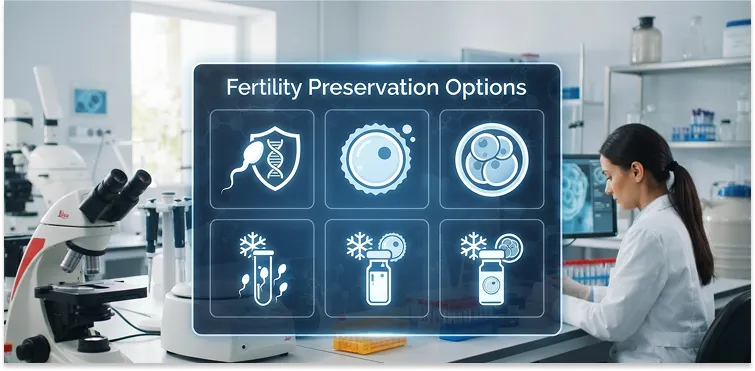
Fertility can be affected by age, medical conditions, cancer treatment, and other factors. Fertility preservation can help protect your reproductive options for the future.
Options include egg freezing, embryo freezing, sperm freezing, and reproductive tissue freezing. The right choice depends on your individual circumstances and future family-building plans.
Understanding each option can help you make a more informed decision with a fertility specialised clinic, where a specialist can guide you based on your individual needs.
Fertility preservation involves collecting and storing eggs, sperm, embryos, or reproductive tissue so they may potentially be used for pregnancy in the future.
The aim is to preserve reproductive potential before fertility is affected by factors such as:
The right fertility preservation method depends on your individual circumstances. There is no single treatment that is best for everyone.
For people who have ovaries, fertility preservation may involve freezing eggs, embryos, or ovarian tissue.
Egg freezing treatment involves stimulating the ovaries, collecting mature eggs, and freezing them for possible future use. It allows you to preserve eggs without creating embryos.
Age is important because egg quality and quantity decline over time. Egg freezing does not guarantee pregnancy, but freezing eggs earlier may improve future chances.
Embryo freezing involves fertilising collected eggs with sperm and freezing the resulting embryos. It can be an option when you are ready to create embryos now.
Frozen embryos can be stored and later used during IVF treatment. This may suit people with a partner or those using donor sperm.
Ovarian tissue freezing involves removing and freezing ovarian tissue containing immature eggs. The tissue may later be used to help restore ovarian function or support pregnancy.
It can be considered when there is limited time before medical treatment or when egg freezing is not suitable. It may also be an option for some children and adolescents.
For people who produce sperm, fertility preservation usually focuses on storing sperm or, in selected situations, testicular tissue.
Sperm freezing, or sperm cryopreservation, involves collecting, testing, and freezing sperm for future use. It is one of the most established fertility preservation options for men.
Stored sperm may later be used with IUI, IVF, or ICSI. When possible, several samples may be stored before treatment that could affect sperm production.
Testicular tissue freezing involves removing and storing tissue containing sperm-producing cells. It may be considered when sperm cannot be collected through ejaculation.
This option can be particularly useful for some children or people who cannot provide a semen sample. A fertility specialist can advise whether it is suitable for you.
Age can strongly influence fertility preservation decisions because reproductive potential changes over time.
Age or Life Stage | Fertility Preservation Considerations |
Younger adults | Egg or sperm freezing may provide an opportunity to preserve reproductive material before fertility declines. |
Late 20s to early 30s | Egg or embryo freezing may be considered when parenthood is being delayed. |
Mid to late 30s | A fertility assessment can help determine egg quantity and reproductive potential before choosing preservation. |
40 and above | Options may be more limited because egg number and quality generally decline with age; specialist advice is important. |
Children or adolescents | Tissue preservation may sometimes be considered when future fertility could be affected by medical treatment. |
Age is only one factor. Your ovarian reserve, sperm quality, medical history, and family-building plans also matter.
Some cancer treatments can affect fertility. If treatment is planned, fertility preservation should be discussed as early as possible.
Situation | Potential Preservation Option |
Chemotherapy may affect ovarian function | Egg, embryo, or ovarian tissue freezing |
Pelvic radiotherapy may affect the ovaries | Egg, embryo, or ovarian tissue freezing, depending on circumstances |
Treatment may reduce sperm production | Sperm freezing or, in selected cases, testicular tissue freezing |
Urgent cancer treatment | Ovarian or testicular tissue preservation may be considered when there is limited time |
Childhood cancer treatment | Tissue preservation may be considered in selected patients |
Cancer treatment should not be unnecessarily delayed.
A fertility specialist and oncology team can work together to determine whether preservation can be performed safely within the available treatment window.
People may delay having children because of education, career plans, financial circumstances, relationships, or personal goals.
Family-Building Situation | Possible Option |
Want to preserve eggs without choosing a sperm source | Egg freezing |
Want to preserve embryos with a partner or donor sperm | Embryo freezing |
Produce sperm and want to delay parenthood | Sperm freezing |
Fertility may be affected by a planned medical treatment | Appropriate egg, sperm, embryo, or tissue preservation |
Unsure about future family-building plans | Fertility assessment and specialist counselling |
Preservation can provide additional options for the future, but it cannot completely stop the natural effects of ageing on fertility.
Your relationship status can also influence which treatment is most practical.
Relationship Status | Common Considerations |
Single | Egg or sperm freezing may allow future use with a partner or donor. |
In a relationship | Egg freezing or embryo freezing may be discussed depending on future family plans. |
Married or partnered | Embryo freezing may be suitable when both people wish to preserve embryos together. |
Using donor sperm | Egg freezing or embryo creation with donor sperm may be considered. |
Unsure about future relationships | Egg or sperm freezing may preserve more flexibility for future family-building decisions. |
The decision should always reflect your personal preferences rather than relationship status alone.
Some gender-affirming treatments can affect reproductive function. For this reason, fertility preservation may be discussed before starting treatment.
For someone who produces eggs, options may include egg or embryo freezing and, in selected circumstances, ovarian tissue preservation.
For someone who produces sperm, sperm freezing is commonly considered before treatment that may affect sperm production.
Fertility counselling can help you understand how gender-affirming treatment may affect future fertility and which preservation options are available before treatment begins.
Your medical history can significantly influence the recommended approach.
Medical Situation | Fertility Preservation Options to Discuss |
Cancer diagnosis | Egg, embryo, sperm, or tissue preservation depending on treatment and reproductive function |
Low ovarian reserve | Individualised assessment; earlier preservation may be recommended |
Planned ovarian surgery | Egg or ovarian tissue preservation may be considered |
Planned treatment that may affect sperm production | Sperm or testicular tissue preservation |
Certain genetic or reproductive conditions | Specialist fertility assessment and personalised preservation plan |
Treatment during childhood | Tissue preservation may be considered in selected cases |
Gender-affirming treatment | Egg, embryo, sperm, or tissue preservation depending on reproductive anatomy and treatment plan |
A IVF specialised clinic can help balance preservation opportunities with your immediate medical needs.
Choosing a fertility preservation treatment is a personalised decision. Your fertility specialist will usually consider:
There is no universal “best” fertility preservation treatment. The best option is the one that fits your reproductive goals and medical circumstances.
Before treatment, your fertility clinic may recommend tests to understand your current reproductive health.
For people with ovaries, assessment may include:
For people who produce sperm, assessment may include:
These tests do not perfectly predict future fertility or guarantee treatment success.
They help your specialist create a more appropriate treatment plan.
The process depends on the treatment.
For egg or embryo freezing, ovarian stimulation usually involves hormone medication for around two weeks, followed by monitoring with blood tests and ultrasound scans. Mature eggs are then collected during a short procedure.
Eggs can be frozen directly, or they can be fertilised with sperm to create embryos before freezing.
For sperm freezing, semen samples are collected and processed before being stored at very low temperatures.
Tissue preservation involves a surgical procedure to obtain ovarian or testicular tissue, followed by specialised cryopreservation.
Your fertility team will explain the exact process, expected timeline, medication, and recovery requirements before treatment begins.
Learn more
Success varies considerably between individuals and depends on factors such as age, reproductive health, the number of eggs or embryos stored, sperm quality, and the fertility treatment used in the future.
Younger eggs generally have a lower risk of chromosome abnormalities than eggs collected at an older age. However, egg freezing does not guarantee a baby, and not every frozen egg will survive thawing, fertilisation, embryo development, or pregnancy.
Similarly, freezing sperm preserves sperm for future treatment but does not guarantee successful fertilisation or pregnancy.
Your fertility specialist can provide a more personalised estimate based on your test results and treatment plan.
The cost of fertility preservation varies depending on the treatment, clinic, medication, laboratory services, and storage period.
Potential costs may include:
Before starting treatment, ask your clinic for a complete estimate that separates the initial preservation costs from future storage and treatment costs.
Fertility preservation is generally well established, but every procedure has potential risks and limitations.
Egg freezing involves hormonal stimulation and an egg collection procedure. Medication can cause side effects, while complications from egg collection are uncommon but possible.
The biggest limitation is that fertility preservation cannot guarantee future pregnancy. Some stored eggs, embryos, sperm, or tissue may not ultimately lead to a successful pregnancy.
Age at the time of preservation is also important. Preserving fertility earlier may provide better reproductive potential than waiting until fertility has significantly declined.
Storage requirements, treatment costs, future fertility treatment, and personal circumstances should also be considered.
Fertility preservation can give you more options when future fertility may be uncertain or when you are not ready to have children yet. Egg freezing, embryo freezing, ovarian tissue freezing, sperm freezing, and testicular tissue freezing each have different uses and benefits.
The right choice depends on your age, reproductive health, medical situation, relationship circumstances, future family-building plans, and how quickly treatment may need to begin.
If you are considering fertility preservation, speaking with a fertility specialist early can help you understand your options and make a decision based on your individual circumstances. The earlier you have that conversation, the more time you may have to consider the options available to you.