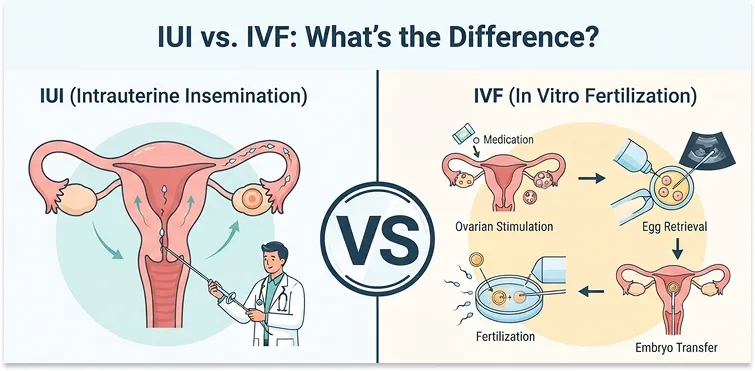
Many couples consider fertility treatments like IUI (Intrauterine Insemination) and IVF (In Vitro Fertilization) when trying to achieve pregnancy. Although both treatments improve the chances of conception, they work in different ways.
The main difference between IUI and IVF is where fertilization takes place. IUI places prepared sperm directly into the uterus, while IVF involves fertilizing eggs with sperm in a laboratory before transferring the embryo.
The right treatment depends on factors such as the cause of infertility, age, reproductive health, and previous fertility treatments. Understanding these differences can help you discuss the best option with a fertility specialist.
Before exploring each treatment in detail, it helps to understand the main differences between IUI and IVF.
The table below highlights how these two fertility treatments compare in terms of process, complexity, cost, success rates, and suitability.
Factor | IUI (Intrauterine Insemination) | IVF (In Vitro Fertilization) |
Fertilization Location | Happens naturally inside the fallopian tube | Happens in a fertility laboratory |
Procedure Complexity | Simple and minimally invasive | More advanced and involved |
Egg Collection | Not required | Required |
Embryo Creation | No embryos created in the lab | Embryos are created in the laboratory |
Success Rate | Lower success rate per cycle | Higher success rate per cycle |
Cost | Generally more affordable | More expensive |
Treatment Duration | Usually shorter | Requires more time and multiple stages |
Best For | Mild fertility problems | More complex infertility issues |
Medication Use | Often involves mild stimulation medication | Usually requires stronger ovarian stimulation |
Control Over Pregnancy Risks | Less control over embryo selection | Greater control through embryo testing and selection |
Understanding how IUI and IVF work can make it easier to see why these treatments are recommended for different fertility situations.
While both aim to help achieve pregnancy, the steps involved, level of medical support, and how fertilization occurs are different.
Intrauterine Insemination (IUI) helps sperm reach the egg more easily by placing prepared sperm directly into the uterus around the time of ovulation. Fertilization then occurs naturally inside the body.
A typical IUI cycle includes:
In Vitro Fertilization (IVF) is a fertility treatment where eggs are collected and fertilized with sperm in a laboratory.
A healthy embryo is then transferred into the uterus. A typical IVF cycle includes:
IUI and IVF differ significantly in the level of medical involvement required.
While IUI is a simpler and less invasive procedure, IVF involves advanced techniques that provide more control over the fertilization process.
IUI is considered a simpler fertility treatment compared with IVF. It usually requires fewer appointments, fewer procedures, and does not involve egg retrieval or embryo handling.
The treatment is similar to a natural conception process but improves the chances by placing sperm closer to the egg.
IUI may be recommended as a first treatment option for couples with:
This type of mucus helps sperm move more easily through the cervix toward the egg.
IVF is a more complex fertility treatment because it involves multiple medical procedures and laboratory techniques.
It allows fertility specialists to carefully monitor egg development, fertilization, embryo quality, and implantation. IVF may also include advanced options such as Preimplantation Genetic Testing (PGT) to check embryos for certain genetic conditions.
IVF is commonly recommended when previous fertility treatments have not worked or when there are more serious fertility challenges.
The best fertility treatment depends on the underlying cause of infertility and individual health factors.
Understanding which conditions each treatment is designed for can help determine whether IUI or IVF may be the more suitable option.
IUI is often suitable for couples experiencing less severe fertility issues. It works best when at least one fallopian tube is open, and the sperm quality is adequate.
Common situations where IUI may help include:
However, IUI may not be effective when there are major problems with egg quality, blocked fallopian tubes, or severe male infertility.
IVF can help with a wider range of fertility problems because it bypasses many natural barriers to conception.
IVF may be recommended for:
Success rates can vary between IUI and IVF based on factors such as age, fertility health, egg and sperm quality, and the reason for infertility.
Comparing their success rates can help patients understand the potential outcomes of each treatment option.
The success rate of IUI varies depending on factors such as age, sperm quality, ovulation health, and the cause of infertility.
Generally, IUI has a lower success rate per cycle because fertilization still happens naturally inside the body. Several cycles may be recommended before moving to another treatment option.
IVF generally has higher success rates compared with IUI because specialists have more control over the fertilization process and embryo selection.
Factors affecting IVF success include:
A fertility specialist can provide a more accurate success estimate based on individual circumstances.
The cost of fertility treatment is an important consideration for many individuals and couples.
While both IUI and IVF involve medical care and fertility support, they differ significantly in terms of overall cost and the procedures included.
IUI is usually less expensive than IVF because it requires fewer medications, fewer procedures, and no laboratory embryo development.
For many couples, IUI is considered an initial fertility treatment before moving to more advanced options.
IVF costs more because it involves:
Although IVF is more expensive, it may provide better chances for couples with complex fertility challenges.
IUI and IVF also differ in how long each treatment cycle takes.
Understanding the timeline for both procedures can help you plan your treatment and know what to expect throughout the fertility journey.
An IUI cycle is usually completed within a few weeks and involves fewer steps than IVF. The procedure is quick, and most people can continue their normal activities afterward.
The IUI timeline typically includes:
An IVF cycle usually takes several weeks because it involves multiple stages, including egg stimulation, retrieval, fertilization, and embryo transfer.
The IVF timeline typically includes:
Some patients may also choose a frozen embryo transfer at a later stage depending on their treatment plan.
Fertility medications play different roles in IUI and IVF treatment.
While IUI may require little or no medication, IVF typically involves a more structured medication plan to stimulate the ovaries and support successful embryo development.
IUI may be done with a natural cycle or mild fertility medications. The goal is usually to support ovulation and improve the chances of sperm meeting the egg.
Common medication steps may include:
IVF requires stronger hormone medications to stimulate the ovaries and produce multiple eggs for retrieval. These medications help increase the chances of creating healthy embryos.
The IVF medication process may include:
One of the biggest differences between IUI and IVF is how and where fertilization takes place.
Knowing how each treatment works can help you better understand why IVF offers greater medical control than IUI.
With IUI, fertilization happens naturally inside the reproductive system. The treatment increases the chance of conception by placing prepared sperm closer to the egg.
The process includes:
With IVF, fertilization takes place in a laboratory. Eggs and sperm are combined under controlled conditions, and the resulting embryo is monitored before transfer.
The process includes:
The number of treatment cycles needed to achieve pregnancy can vary from person to person.
Comparing IUI and IVF can provide a clearer idea of how many attempts are commonly recommended before considering the next step.
IUI often involves trying multiple cycles before moving to another treatment option. It is commonly recommended when fertility concerns are mild.
The treatment approach may include:
IVF may require fewer attempts because it generally has a higher success rate per cycle. However, some patients may need more than one IVF cycle to achieve pregnancy.
The treatment plan may depend on:
Both IUI and IVF are designed to help achieve a healthy pregnancy, but they offer different levels of medical control.
Understanding these differences can help you see how each treatment manages factors that may affect pregnancy outcomes.
With IUI, fertilization happens naturally inside the body, so there is limited control over the fertilization process.
Key points include:
With IVF, specialists can monitor embryo development before transferring an embryo into the uterus. This provides more control over certain pregnancy-related factors.
Key points include:
The choice between IUI and IVF depends on your individual fertility situation.
IUI may be a good starting option for couples with mild female fertility concerns, while IVF may be more suitable for complex infertility conditions or when previous treatments have been unsuccessful.
A fertility specialist will usually consider:
There is no single treatment that works best for everyone. The right approach depends on finding the treatment that matches your specific needs.
Learn more
The main difference between IUI and IVF is the level of medical assistance involved. IUI is a simpler and more affordable treatment that helps sperm reach the egg naturally, while IVF is a more advanced procedure where fertilization and embryo development are managed in a laboratory.
For couples with mild fertility challenges, IUI may be an effective first step. For those with blocked tubes, severe infertility, age-related fertility concerns, or unsuccessful previous treatments, IVF may offer a better chance of achieving pregnancy.
Speaking with an experienced fertility specialist is the best way to understand which option is most suitable for your fertility journey.