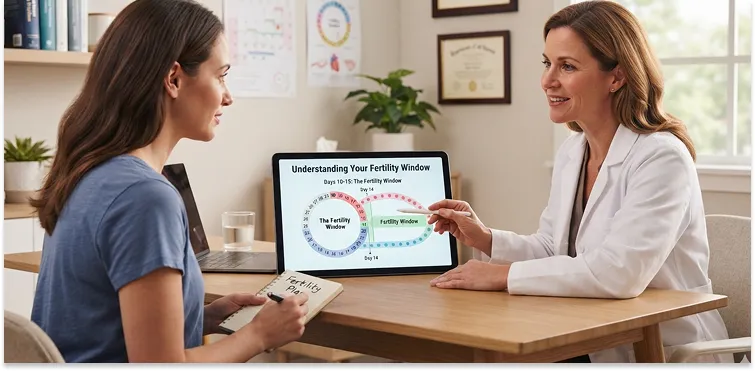
If you’re trying to get pregnant, understanding your fertility window can significantly improve your chances of conception. Pregnancy is only possible during a few days of each menstrual cycle, making the right timing important.
The fertility window is the period around ovulation when an egg is available for fertilization. Since sperm can survive for several days but the egg lives for only about 12 to 24 hours, knowing your fertile days can help you plan intercourse more effectively.
This guide explains what the fertility window is, when you’re most likely to conceive, how to identify your fertile days, and practical ways to support your fertility journey.
The fertility window is the period during your menstrual cycle when pregnancy is most likely to happen. It includes the days leading up to ovulation and the day of ovulation itself.
A pregnancy occurs when a healthy sperm meets a healthy egg in the fallopian tube.
Since sperm can survive inside the reproductive tract for up to five days, and an egg remains viable for about 24 hours after release, there is only a limited timeframe each cycle when conception is possible.
For most women, the fertility window lasts approximately six days.
Knowing your fertility window helps you:
Many couples assume pregnancy can happen on any day of the month.
In reality, conception is much more likely during the fertile window than at other times in the cycle.
The highest chance of pregnancy occurs during the two days before ovulation and on the day of ovulation.
Research has shown that sperm already present in the reproductive tract before the egg is released have the greatest opportunity to fertilize it.
Waiting until after ovulation may reduce the chance of conception because the egg survives for only a short period.
Although every menstrual cycle is different, many women ovulate around the middle of their cycle. For example, someone with a regular 28-day cycle often ovulates around day 14.
The fertility window includes:
Here’s why these six days matter:
After the egg has been released for more than 24 hours without fertilization, pregnancy is unlikely until the next menstrual cycle.
If your goal is pregnancy, focus on having intercourse during the following days:
These days generally provide the highest likelihood of conception because both sperm and egg are present at the optimal time.
Many fertility specialists recommend having intercourse every one to two days during the fertile window rather than trying to predict the exact hour of ovulation.
Ovulation is the event that determines your fertility window.
During ovulation:
If ovulation does not occur, pregnancy cannot happen during that cycle.
Several hormones work together to trigger ovulation, including:
Understanding ovulation helps explain why fertility changes throughout the menstrual cycle.
Many women notice physical signs that indicate ovulation is approaching.
Common signs include:
Not everyone experiences all these signs, which is why combining multiple tracking methods often provides better accuracy.
Calculating your fertility window begins with understanding your menstrual cycle length.
For women with regular cycles:
For example:
Women with irregular cycles may need additional tracking methods because ovulation can vary from month to month.
There are several ways to identify your fertile window more accurately.
Using one or a combination of these methods can help you better understand your menstrual cycle and improve your chances of timing intercourse for conception.
Combining multiple methods can help you identify your fertile window more accurately.
Experts generally recommend having intercourse every one to two days throughout the fertile window.
This approach:
Couples do not usually need to have intercourse multiple times in one day.
Consistent timing across the fertile window is generally more important.
Several factors may influence when ovulation occurs and how predictable your fertility window is.
These include:
If your cycles change frequently or ovulation appears irregular, speaking with a healthcare provider may be helpful.
While no method guarantees pregnancy, healthy habits can support fertility.
Consider these tips:
Both male and female fertility contribute to successful conception, so healthy lifestyle choices benefit both partners.
Tracking fertility works best when both partners are involved.
Couples can:
Working together often makes the conception journey more manageable and less overwhelming.
Learn more
Although many healthy couples conceive naturally, fertility testing may be appropriate if pregnancy is taking longer than expected.
You may want to speak with a fertility specialist clinic if:
Fertility testing may include hormone blood tests, ovulation assessment, semen analysis, ultrasound, or imaging of the uterus and fallopian tubes, depending on your medical history.
Understanding your fertility window can help improve your chances of conceiving by allowing you to identify the best time for intercourse. Since fertility is limited to a few days each cycle, tracking ovulation is an important step.
Using methods like cycle tracking, ovulation tests, and fertility apps can make it easier to recognize your fertile days. Remember that every person’s cycle is different and can be affected by various factors.
If you have been trying to conceive without success, consulting a fertility specialist can provide guidance, testing, and support based on your individual needs.